
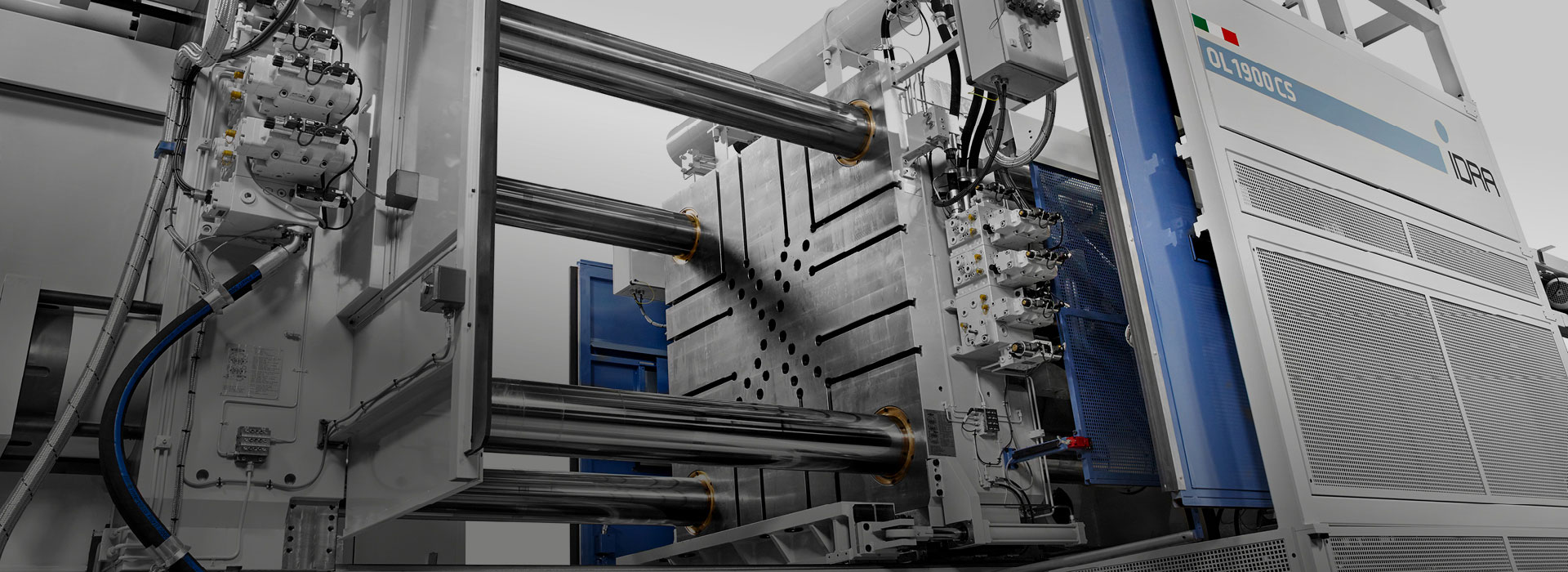
High Pressure Die Casting (HPDC) is widely used to manufacture metal components with complex geometries, good dimensional accuracy, and high productivity. In practice, the process injects molten metal into a die at controlled speeds and pressures.
For this reason, manufacturers use HPDC across the automotive, electronics, telecommunications, and industrial equipment sectors. However, casting quality depends on more than machine capability. In addition, die design, molten metal quality, injection parameters, and process control play important roles.
1. Introduction
Today, the manufacturing industry continually requires lightweight, precise components that can be produced consistently in large quantities. As a result, this demand drives the use of manufacturing processes that combine production efficiency with component quality.
To meet these requirements, High Pressure Die Casting offers one effective solution. During this process, the machine injects molten metal into the die cavity at high speed. Once the metal fills the cavity, the machine maintains pressure for a defined period while the component solidifies.
Nevertheless, HPDC also presents technical challenges despite its high productivity. For example, air entrapment, porosity, incomplete filling, and die-surface problems can affect product quality. Understanding each process stage is therefore essential to improving casting quality and maintaining production efficiency.
2. What Is High Pressure Die Casting?
In technical terms, High Pressure Die Casting is a metal casting process in which molten metal is injected into a die at high pressure and speed. Manufacturers typically use tool steel for the die and design it to withstand many production cycles.
Unlike gravity casting, which relies on gravity to fill the cavity, HPDC uses an injection system to force molten metal into the die. This makes it possible to produce components with complex geometric details and relatively thin walls, provided the part design and process conditions support them.
In practice, common materials include aluminium, zinc, and magnesium alloys. For this reason, alloy selection depends on mechanical requirements, component weight, corrosion resistance, operating temperature, and end-use application requirements.
2.1. Cold Chamber Die Casting
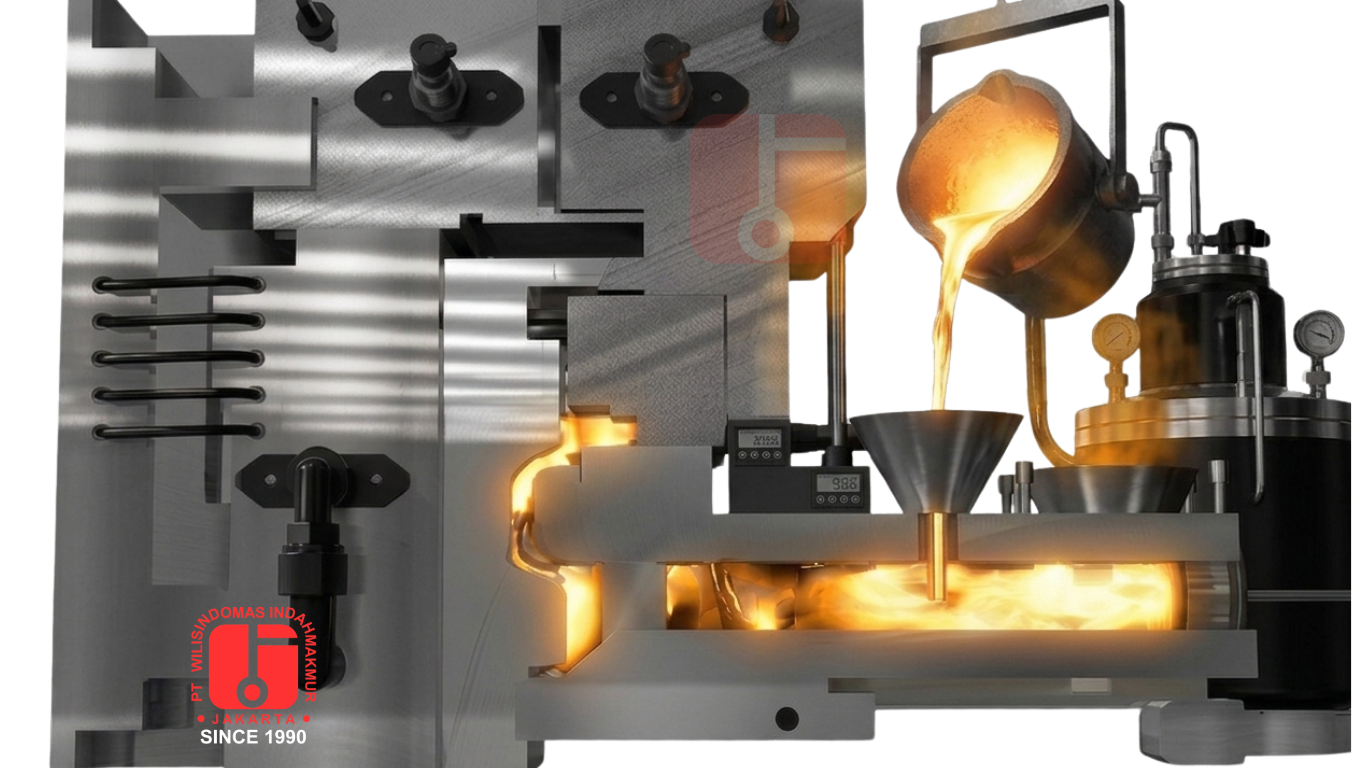
First, in a cold-chamber system, an operator or dosing system pours molten metal into the shot sleeve; a plunger then pushes it toward the cavity. As a result, manufacturers commonly use this system for aluminium and magnesium alloys.
Therefore, because molten metal enters the injection system during every cycle, operators must control metal dosing, temperature, and shot sleeve conditions carefully.
2.2. Hot Chamber Die Casting
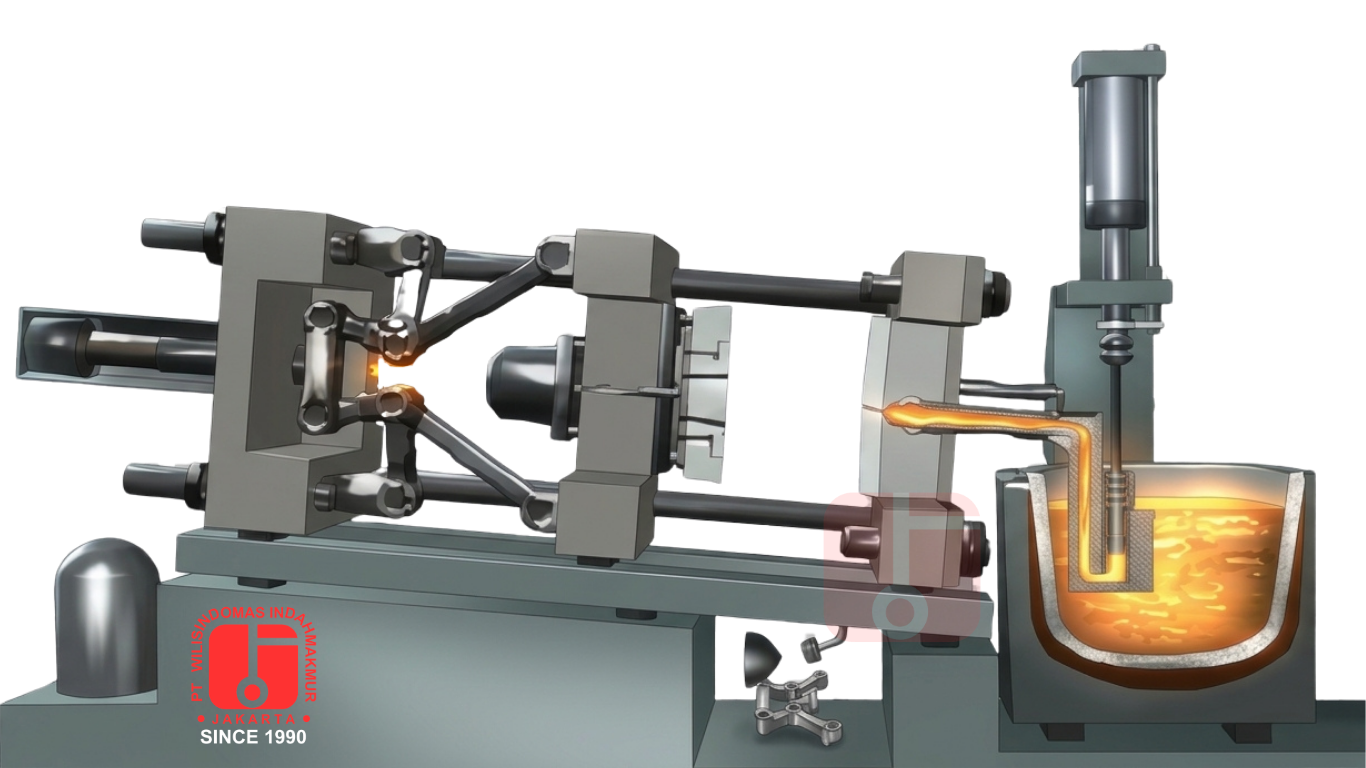
By contrast, in a hot-chamber system, the injection mechanism connects directly to the molten metal reservoir. This configuration enables rapid filling and is commonly used for zinc alloys and other materials suited to the system’s operating characteristics.
Ultimately, the choice between cold-chamber and hot-chamber systems depends on the alloy type, process temperature, machine characteristics, and production requirements.
3. Working Principle of HPDC
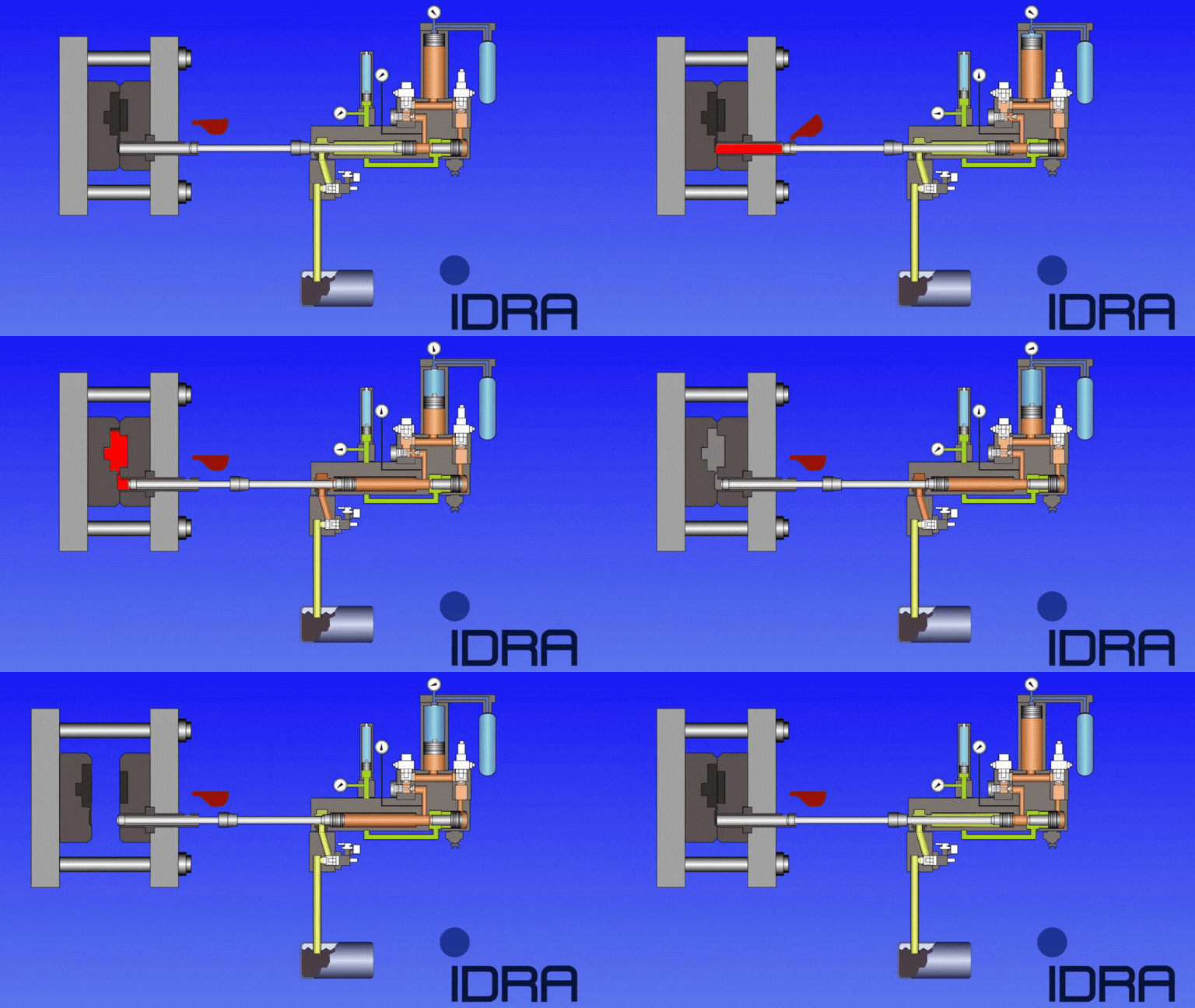
At its core, HPDC fills the cavity with molten metal through high-speed injection and then controls pressure and thermal conditions during solidification.
- Die filling: The plunger pushes molten metal through the shot sleeve, runner, and gate into the cavity.
- Intensification: The machine increases or maintains pressure according to its programmed profile to support filling and solidification.
- Solidification: Heat transfers from the molten metal to the die until the component forms a solid structure.
- Ejection: The machine opens the die and ejects the casting once it has solidified sufficiently.
Meanwhile, plunger speed, gate velocity, intensification pressure, molten metal temperature, and die temperature are key parameters that operators must control. As a result, they affect flow patterns, the likelihood of air entrapment, solidification, and final casting quality.
However, high pressure does not automatically guarantee defect-free castings. Runner and gate design, the venting system, and the injection profile must be designed to fill the cavity properly and allow air to escape effectively.
4. HPDC Process Stages
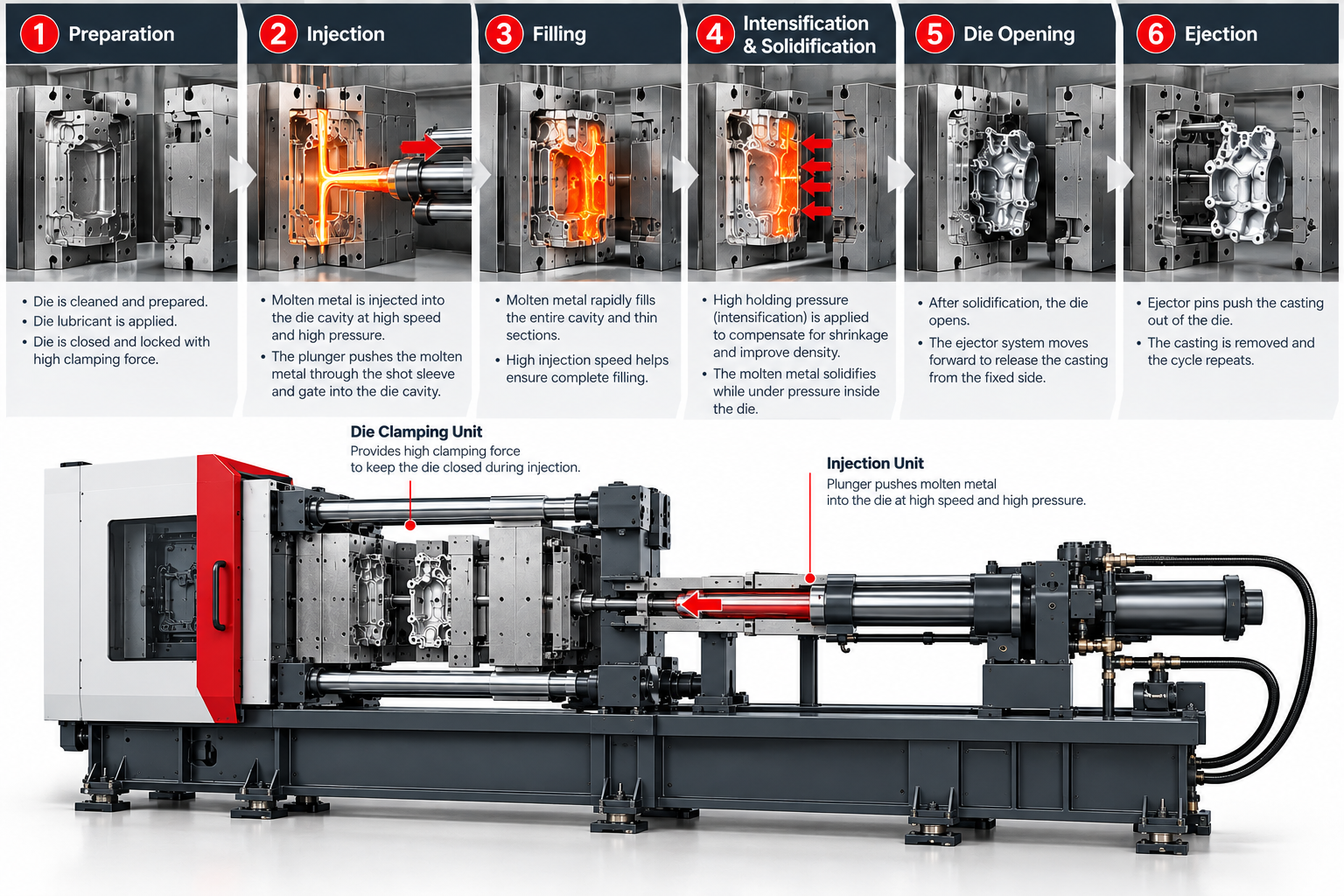
4.1. Die Preparation
Before production begins, technicians inspect the die to confirm that it meets process requirements. They check the surface, set the temperature, clean the die, and apply die lubricant as needed.
In addition, die lubricant helps reduce the risk of soldering, supports casting release, and affects heat transfer between the casting and the die. However, excessive or uneven application can affect surface quality and process stability.
Likewise, technicians should check the venting system and, where used, the vacuum system to help reduce trapped air during die filling.
4.2. Molten Metal Preparation
Operators melt the alloy and maintain the molten metal at a suitable temperature before transferring it to the HPDC machine. Temperature control must account for the alloy type, filling requirements, and solidification characteristics.
Beyond temperature control, operators must also monitor melt quality. For example, gas content, oxide inclusions, and changes in alloy composition can affect casting quality. Control of melting, melt treatment, and transfer is therefore important for maintaining consistent results.
4.3. Shot Sleeve Filling and Injection
In cold-chamber HPDC, an operator or dosing system pours molten metal into the shot sleeve. The plunger then pushes it through the runner and gate into the cavity.
Typically, plunger movement is divided into slow-shot and fast-shot phases. More specifically, slow shot helps control molten metal movement inside the shot sleeve, while fast shot fills the cavity in a short time.
For this reason, the plunger speed profile must match the die design, alloy characteristics, and component requirements. Otherwise, an unsuitable profile can increase turbulence, air entrapment, and oxide-film formation inside the casting.
4.4. Intensification and Solidification
Next, after the metal fills the cavity, the machine applies intensification pressure according to the process settings. This pressure helps maintain pressure during solidification, but its effectiveness depends on the gate condition and the feeding path before they solidify.
As solidification proceeds, the molten metal transfers heat to the die. In turn, temperature differences, thickness distribution, and alloy characteristics affect the solidification rate and the likelihood of shrinkage porosity.
Even so, pressure control cannot eliminate every type of porosity. For this reason, teams must evaluate die design, gate location, thermal balance, and injection parameters together.
4.5. Die Opening and Ejection
Once the casting has solidified sufficiently, the machine opens the die, and the ejector system pushes the casting out of the cavity. Ejection conditions must be controlled to reduce the risk of deformation, cracking, or surface damage.
Soldering, insufficient draft angles, and unsuitable temperature conditions can make casting removal more difficult. In turn, regular die inspections help maintain process stability.
4.6. Trimming and Finishing
After ejection, castings generally retain excess material around the gate, runner, and overflow. At this stage, trimming removes this material.
Depending on design requirements, finishing may also include deburring, surface treatment, machining, and additional operations. Not every casting requires all of these processes.
4.7. Quality Inspection
Quality inspectors check each casting against the specified requirements. Depending on the application, they may use the following methods:
- Visual inspection to identify surface defects.
- Dimensional inspection to check dimensions and tolerances.
- Leak testing for components that must be sealed against gas or fluids.
- Mechanical testing according to application requirements.
- Radiography or other non-destructive testing methods to evaluate internal defects when required.
Therefore, teams must select inspection methods according to the component’s function, customer specifications, and the risk of failure in the final application.
5. Advantages of HPDC
5.1. High Productivity
HPDC has a relatively short production cycle and is suitable for repeated, high-volume manufacturing. Furthermore, once die design and process parameters are optimized, the process can deliver high output with consistent results.
5.2. Complex Geometries
Beyond these capabilities, HPDC can produce components with complex geometries, integrated details, and relatively thin walls. Designers can also combine multiple features in a single casting, reducing the number of parts that require assembly.
5.3. Dimensional Accuracy
Under controlled conditions, a permanent die helps produce consistent dimensions. Nevertheless, shrinkage, thermal conditions, die wear, and production stability can still affect dimensional accuracy.
5.4. Automation Potential
Furthermore, manufacturers can integrate injection, ejection, trimming, and some inspection stages with automation systems. As a result, this integration helps improve repeatability and reduce reliance on manual work.
5.5. Material and Production Efficiency
HPDC can produce components close to their final shape (near-net shape), reducing machining requirements for certain designs. Nevertheless, material efficiency and production cost must account for runners, gates, scrap rate, die investment, and finishing requirements.
6. Common HPDC Defects
In general, casting defects often arise from a combination of melt quality, die design, injection parameters, and thermal conditions. Teams should identify root causes through physical inspection and process data rather than relying on appearance alone.
6.1. Gas Porosity
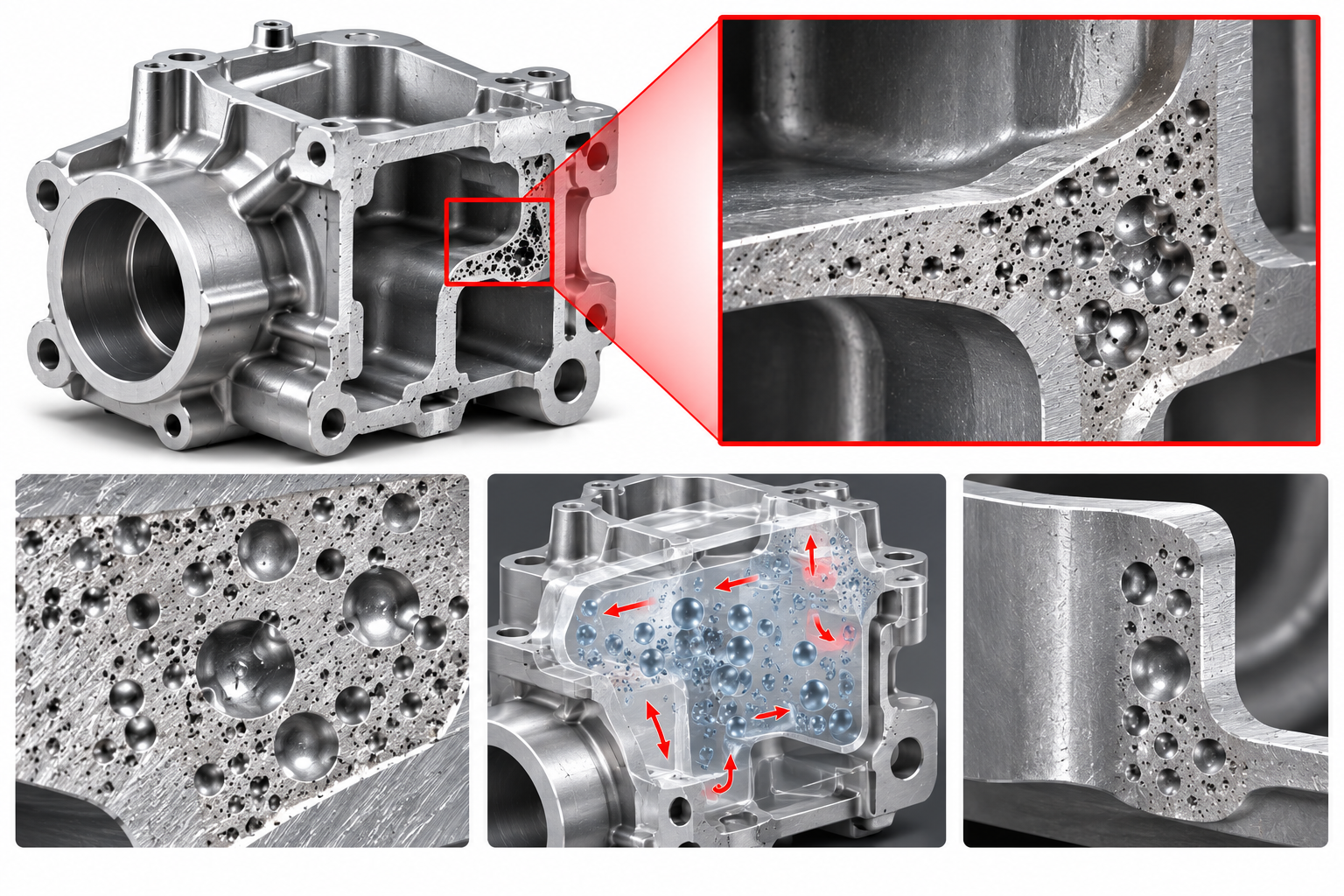
Gas porosity forms when gas remains trapped inside the casting. For instance, air entrapment during die filling is one mechanism to investigate, along with molten metal conditions and other process characteristics.
To address this issue, control measures may include optimizing the plunger speed profile, improving venting, evaluating the runner and gate, and using a vacuum system when appropriate.
6.2. Shrinkage Porosity
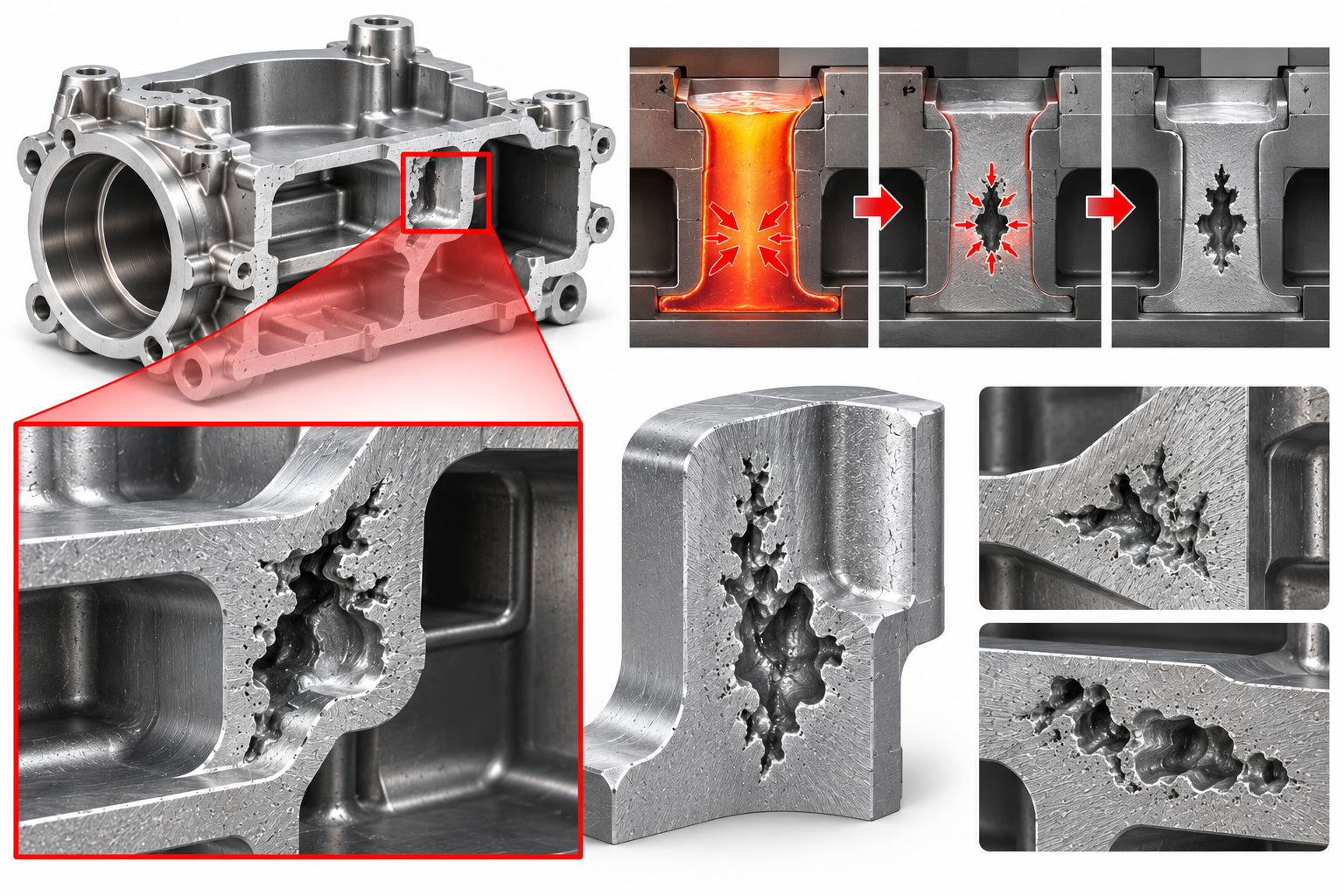
Shrinkage porosity is associated with volume changes as the alloy solidifies and inadequate feeding in certain areas. Risk can be affected by thickness distribution, thermal conditions, gate location, and solidification characteristics.
6.3. Cold Shut and Misrun
For example, a cold shut develops when two streams of molten metal meet but do not fuse properly. A misrun develops when molten metal cannot fill the entire cavity.
To identify the cause, investigate molten metal temperature, die temperature, injection speed, gate design, and flow conditions during die filling.
6.4. Soldering
Soldering develops when casting material adheres to or reacts with the die surface. Consequently, soldering can make ejection difficult, damage the casting surface, and increase die maintenance requirements.
Accordingly, controlling die temperature, die lubricant, die material, and surface condition helps prevent soldering.
6.5. Flash
Flash forms when metal escapes through a gap at the parting line or another area of the die. For example, excessive or insufficient clamping force, die wear, parting-surface damage, or unsuitable process conditions can cause flash.
To prevent recurrence, flash generally requires trimming and an evaluation of die condition and machine parameters.
7. Industrial Applications of HPDC
7.1. Automotive Industry
In the automotive industry, manufacturers use HPDC to produce transmission housings, motor housings, structural components, and other parts that require complex geometries and efficient production.
7.2. Electronics and Electrical Industry
In the electronics and electrical industries, HPDC can likewise produce electronic enclosures, heat sinks, and housings that require dimensional accuracy and thermal management.
7.3. Industrial Machinery
For industrial machinery, manufacturers can produce pump housings, gearbox housings, and certain mechanical parts with HPDC when the material, strength, and design requirements suit the process.
7.4. Telecommunications
Telecommunications manufacturers use HPDC for enclosures and structural housings that require precise shapes and integrated features.
7.5. Consumer and Commercial Equipment
Consumer and commercial equipment manufacturers use die-cast components when the required shape, surface finish, material, and production volume suit the process.
Even so, selecting HPDC requires careful consideration of component function, quality requirements, alloy, and production volume. Ultimately, not every component in these industries needs to be manufactured using HPDC.
8. Key Factors in HPDC Process Optimization
Consistent castings depend on evaluating all process elements as a single system. The following key factors can help guide that evaluation:
- Part design: Designers must match wall thickness, transition areas, draft angles, and tolerances to the process capabilities.
- Alloy selection: Engineers should select alloys based on mechanical properties, corrosion resistance, operating temperature, and castability.
- Die design: Engineers use runner, gate, overflow, venting, and cooling-channel design to manage molten metal flow and temperature distribution.
- Injection parameters: Process engineers should match slow shot, fast shot, gate velocity, and intensification pressure to the component’s characteristics.
- Thermal control: Molten metal temperature and die temperature affect filling behaviour and solidification.
- Melt quality: Teams must control alloy composition, gas content, and oxide inclusions to maintain consistent results.
- Quality monitoring: Process data, inspection results, and defect analysis help identify deviations and determine corrective actions.
- Casting simulation: Simulation can help evaluate filling patterns, heat transfer, solidification, and potential defects before the die is manufactured. Simulation results must still be validated against actual production data.
Ultimately, an integrated approach combining design engineering, casting simulation, process monitoring, and quality inspection can reduce trial and error and improve process stability.
9. Conclusion
High Pressure Die Casting uses high-speed injection and controlled pressure to produce components with complex geometries and good dimensional accuracy.
Overall, the process offers high productivity, automation potential, and the ability to produce near-net-shape components. Nevertheless, melt quality, die design, injection parameters, thermal control, and defect management still determine casting quality.
In conclusion, successful HPDC production requires more than machine capability. Teams must control the entire process and support their decisions with engineering analysis and quality monitoring to produce consistent castings efficiently.
References
- Adamane, A. R., Arnberg, L., Fiorese, E., Timelli, G., et al. (2015). “Influence of Injection Parameters on the Porosity and Tensile Properties of High-Pressure Die Cast Al-Si Alloys: A Review.” International Journal of Metalcasting, 9, 43–53. https://doi.org/10.1007/BF03355601
- Lordan, E., Zhang, Y., Dou, K., Jacot, A., Tzileroglou, C., Wang, S., Wang, Y., Patel, J., Lazaro-Nebreda, J., Zhou, X., Hashimoto, T., and Fan, Z. (2022). “High-Pressure Die Casting: A Review of Progress from the EPSRC Future LiME Hub.” Metals, 12(10), 1575. https://doi.org/10.3390/met12101575
- Butler, W. A. (2008). “High-Pressure Die Casting.” In ASM Handbook, Volume 15: Casting, pp. 715–718. ASM International. https://doi.org/10.31399/asm.hb.v15.a0005266

Your Industrial Solutions Partner
PTWI High Pressure Die Casting Machine Solutions
PT Wilisindomas Indahmakmur (PTWI) provides High Pressure Die Casting (HPDC) machines to support efficient and reliable production in the Aluminium Die Casting industry.
Contact our team to discuss machine specifications, configuration options, and solutions suited to your production requirements.
Discuss Your Requirements