
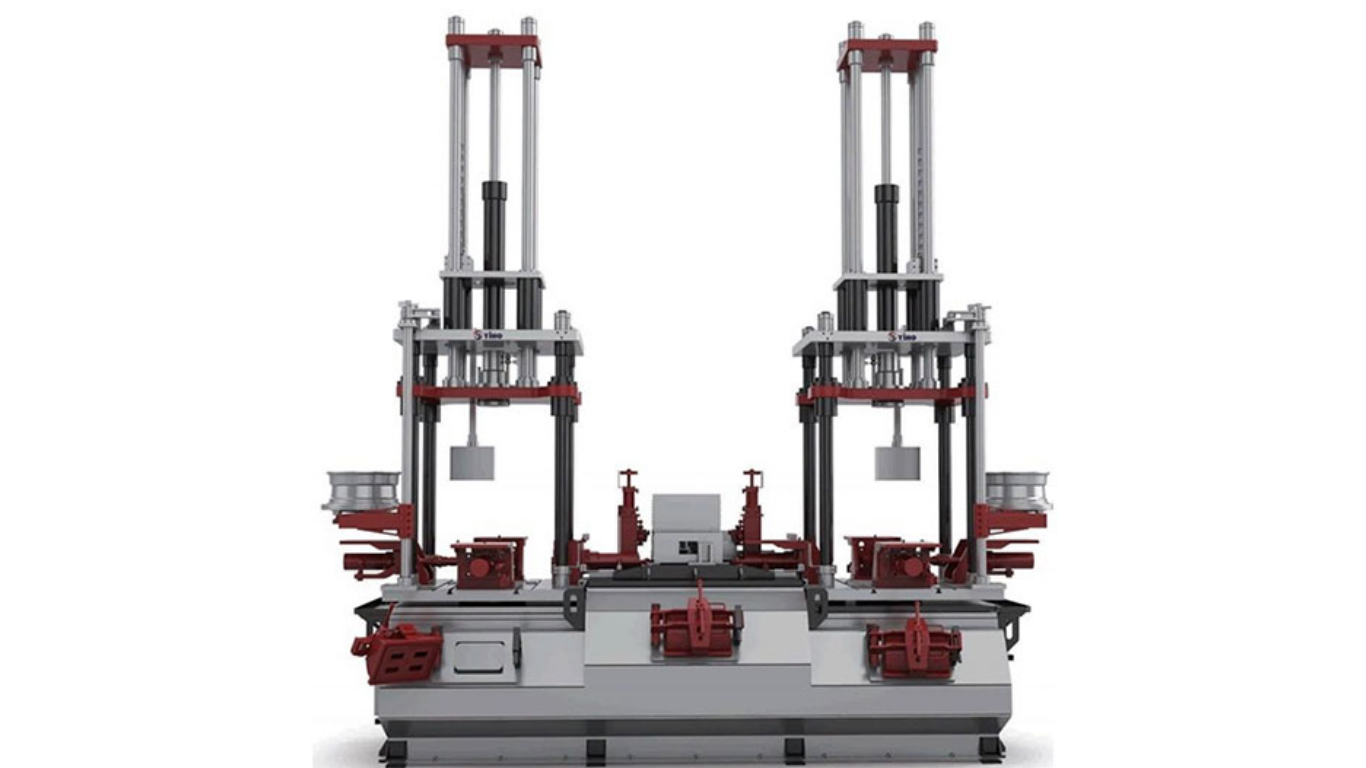
In the Aluminium Die Casting industry, the casting process you select affects component quality, production consistency, finishing requirements, and manufacturing costs. Low Pressure Die Casting (LPDC) uses relatively low gas pressure to push Molten Aluminium from a holding furnace into a Die through a filling passage that typically connects from below.
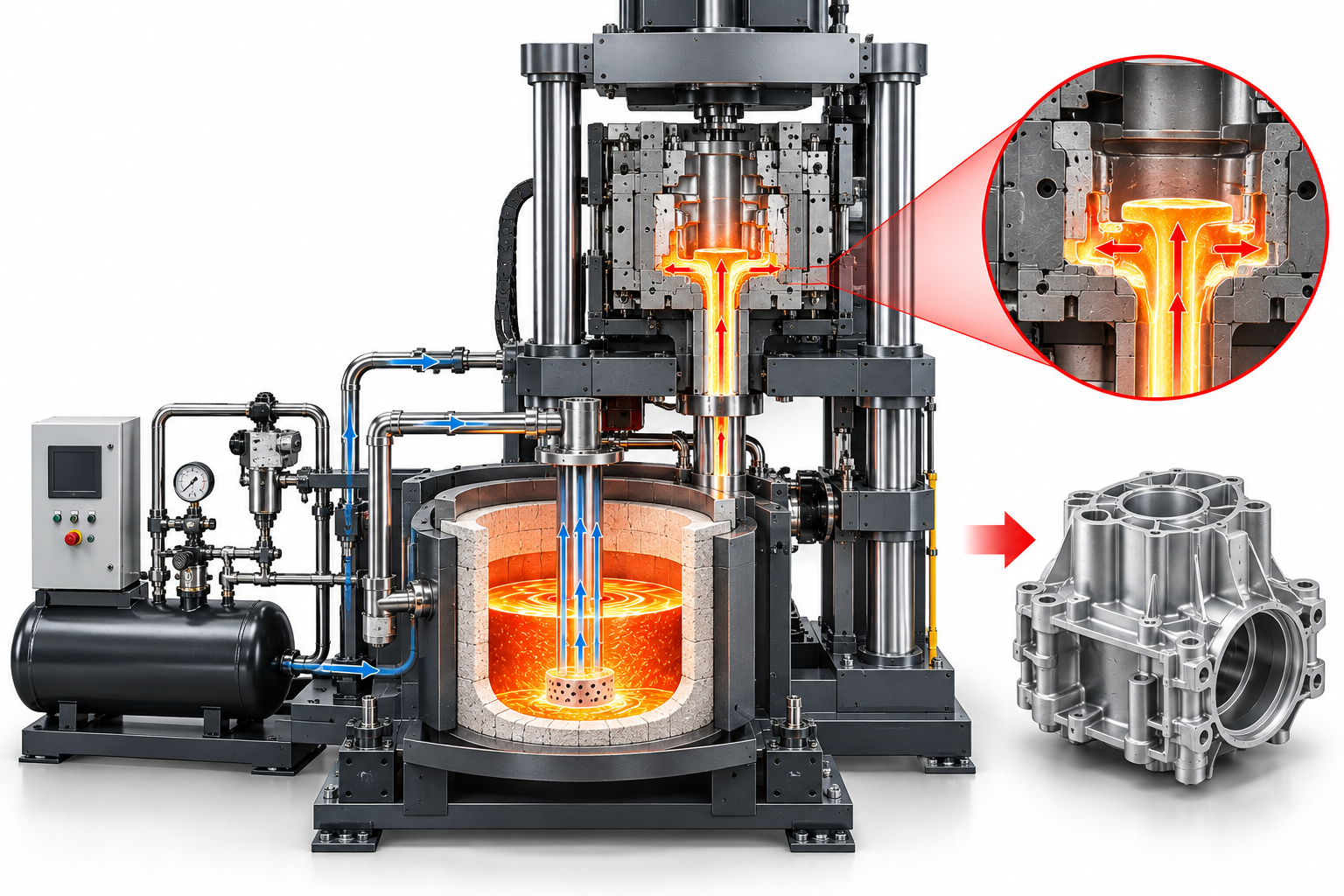
Unlike High Pressure Die Casting (HPDC), which injects molten metal at high speed using a Shot Sleeve and Plunger system, LPDC relies on a controlled increase in pressure to fill the Die cavity. This mechanism enables a more controlled filling process and supports managed Solidification.
Understanding LPDC matters because Die design alone does not determine casting quality. Pressure settings, metal temperature, Die temperature, filling speed, and Solidification conditions also influence the final result.
1. What Is Low Pressure Die Casting?
Low Pressure Die Casting (LPDC) is a casting process that uses gas pressure to push Molten Aluminium from a furnace into a Die cavity positioned above it.
In a common configuration, the operator seals the holding furnace with a cover. A Riser Tube connects the molten metal in the furnace to the Die. When the system applies gas pressure to the space above the molten metal surface, that pressure pushes Molten Aluminium up through the Riser Tube and into the Die cavity.
Once Molten Aluminium fills the Die cavity, the system maintains pressure during Solidification according to process requirements. After the metal solidifies and the casting gains sufficient strength, the system reduces pressure in a controlled manner. Depending on the system design and process sequence, molten metal remaining in the filling passage may return to the furnace.
Bottom filling is one of the defining characteristics of LPDC. Appropriate pressure control helps operators manage metal flow, reduce turbulence, and minimize the risk of air entrainment or oxide formation associated with unstable flow.
1.1 Main Components of an LPDC System
Holding Furnace
Holds Molten Aluminium and keeps its temperature stable throughout the process. Temperature stability and melt condition affect filling behavior and casting quality.
Riser Tube
Connects the Molten Aluminium in the furnace to the Die. The tube material and condition must be suitable for the process temperature and operating environment.
Die and Die Cavity
Define the component geometry. Die temperature, the venting system, and cavity design influence how metal fills the cavity and solidifies.
Pressure Control System
Controls the gas pressure profile that raises the molten metal, fills the Die, maintains pressure during Solidification, and reduces pressure at the end of the cycle.
2. How the LPDC Process Works
LPDC uses a pressure difference to move Molten Aluminium from the furnace into the Die. Pressure is not only used to fill the cavity; it can also help maintain the metal supply during Solidification.
2.1 Die and Molten Aluminium Preparation
Before casting begins, operators clean and prepare the Die, then heat it to an appropriate operating condition. Where required, they apply a Die Coating to manage heat transfer, protect the Die surface, and support casting release.
Operators prepare Molten Aluminium at a temperature suited to the alloy and component requirements. Temperature control, melt cleanliness, and Melt Treatment processes such as degassing play important roles in material preparation.
2.2 Filling the Riser Tube
The Pressure Control System applies gas pressure above the Molten Aluminium in the furnace. This pressure pushes the metal upward through the Riser Tube toward the Die inlet. The system must increase pressure in a controlled manner to prevent excessively rapid movement or sudden surges in flow.
2.3 Filling the Die Cavity
Once Molten Aluminium reaches the inlet, the system regulates pressure so the metal flows into and fills the Die Cavity in a controlled way. Important factors include the Pressure Ramp Profile, Metal Flow Velocity, Molten Aluminium and Die temperatures, Runner and Gate geometry, and the venting system that allows air to escape from the cavity.
Stable filling helps reduce the risk of Air Entrapment, folded oxide films, and incomplete filling. However, the filling rate must still be sufficient to prevent the metal from solidifying before the cavity is completely filled.
2.4 Pressure Holding and Solidification
After Molten Aluminium fills the Die Cavity, the system maintains pressure for a specified period. Engineers call this stage Pressure Holding.
As Molten Aluminium solidifies, its volume decreases. Maintaining pressure can help push additional liquid metal through the feeding path while the path remains open and the metal inside it remains liquid. This supports Feeding and can help reduce Shrinkage Porosity in areas affected by contraction.
How effective this mechanism is depends on Die design, the solidification sequence, temperature, pressure profile, and the ability to keep the feeding path open for the required period.
2.5 Depressurization and Ejection
Once the process reaches the required Solidification stage, the system reduces gas pressure in a controlled manner. Molten Aluminium remaining in the Riser Tube may flow back into the furnace if the system configuration allows it.
The machine then opens the Die and removes the casting with the Ejection mechanism. Subsequent operations may include trimming, cleaning, dimensional checks, and quality inspection according to the product specification.
3. Pressure Control in LPDC
Pressure Control is one of the most important aspects of LPDC. Engineers must do more than specify a maximum pressure; they must also control how pressure changes throughout the cycle.
An appropriate pressure profile accounts for the metal lift height, component geometry, alloy characteristics, filling requirements, and Solidification sequence.
3.1 Main Stages of Pressure Control
- Pressure Build-Up. The system increases pressure to push Molten Aluminium through the Riser Tube toward the Die. Operators must control the pressure rise to avoid sudden surges in flow.
- Cavity Filling. The system regulates pressure to fill the Die Cavity steadily, balancing filling time against the risks of turbulence and premature solidification.
- Pressure Holding. The system maintains pressure during Solidification to help feed areas experiencing contraction while the feeding path remains open.
- Depressurization. The system reduces pressure after the required solidification stage, before the machine opens the Die and removes the casting.
3.2 Why Must the Pressure Profile Be Stable?
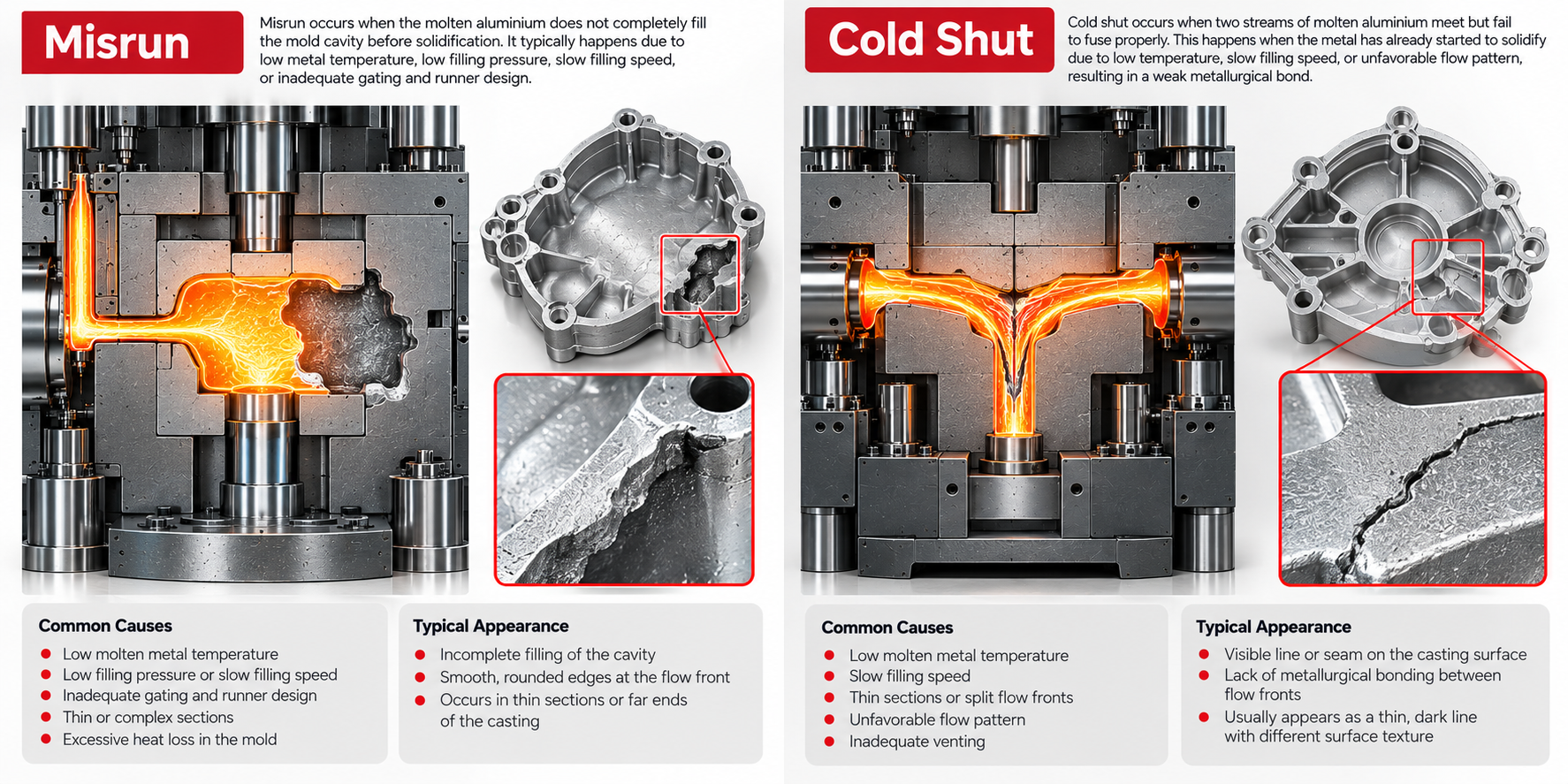
Pressure that is too low may prevent metal from reaching all areas of the Die Cavity or may result in incomplete filling. This can produce defects such as Misrun or Cold Shut, depending on the mechanism involved.
Conversely, pressure changes that are too rapid can increase flow velocity uncontrollably. This may cause turbulence, air entrainment, or oxide films to become trapped in the casting.
Insufficient holding pressure may also reduce the effectiveness of Feeding during Solidification. However, increasing pressure excessively is not a universal solution: operating limits depend on the machine, Die, sealing system, and component characteristics. Engineers should therefore establish pressure settings through process trials and quality validation instead of applying one value to every product.
3.3 Relationship Between Pressure, Temperature, and Filling Time
| Parameter | Potential risk if not optimized |
|---|---|
| Pressure Ramp Rate | Too rapid a rise can cause unstable flow; too slow a rise can extend filling time. |
| Filling Time | Excessive filling time increases heat loss and the risk of premature solidification. |
| Melt Temperature | Too low a temperature can reduce fluidity; too high a temperature can increase thermal load and other material or process risks. |
| Die Temperature | Affects metal flow, cooling rate, and the Solidification pattern. |
| Holding Pressure and Time | Influence Feeding during contraction, provided the feeding path remains open. |
| Cooling Rate | Influences the solidification pattern, microstructure, and potential for defects. |
There is no single ideal parameter combination for every LPDC application. Adjust settings for the alloy, wall thickness, component geometry, Gate location, and required quality level.
4. Factors Affecting LPDC Casting Quality
Casting quality depends on the interaction between Molten Aluminium condition, Die design, pressure control, and cooling. Quality evaluation should therefore consider the entire process rather than inspecting the product only after the machine removes it.
4.1 Molten Aluminium Quality and Cleanliness
Molten Aluminium that contains dissolved gas, oxides, or inclusions can produce internal defects even when operators control machine parameters well. Relevant controls may include appropriate material selection and handling, melting and holding temperature control, degassing where required, limiting oxide formation during transfer and filling, and checking melt quality before production.
4.2 Die and Filling System Design
Engineers should design the Die so metal fills the cavity in a controlled manner while air escapes. Gate position, flow path, wall thickness, and venting influence both filling and solidification. The design should also support Directional Solidification, so that freezing progresses in a sequence that supports feeding toward areas that remain liquid.
4.3 Temperature Control
Molten Aluminium and Die temperatures affect fluidity, filling time, and Solidification. If the Die is too cold or filling is too slow, the metal may lose heat before reaching the entire cavity. Conversely, an unsuitable temperature distribution can create differences in solidification rate and lead to localized problems. Stable temperatures and a well-designed cooling system help improve production consistency.
4.4 Monitoring and Cycle Consistency
Changes in pressure, temperature, or cycle time can indicate a shift in process conditions. Monitoring actual parameters and recording cycle data helps engineers identify variation earlier. Engineers can also analyze production data to investigate relationships between process parameters and observed defects.
5. Common Defects in LPDC
Although LPDC enables controlled filling, casting defects can still occur when material condition, design, or process parameters are not optimized.
5.1 Gas Porosity
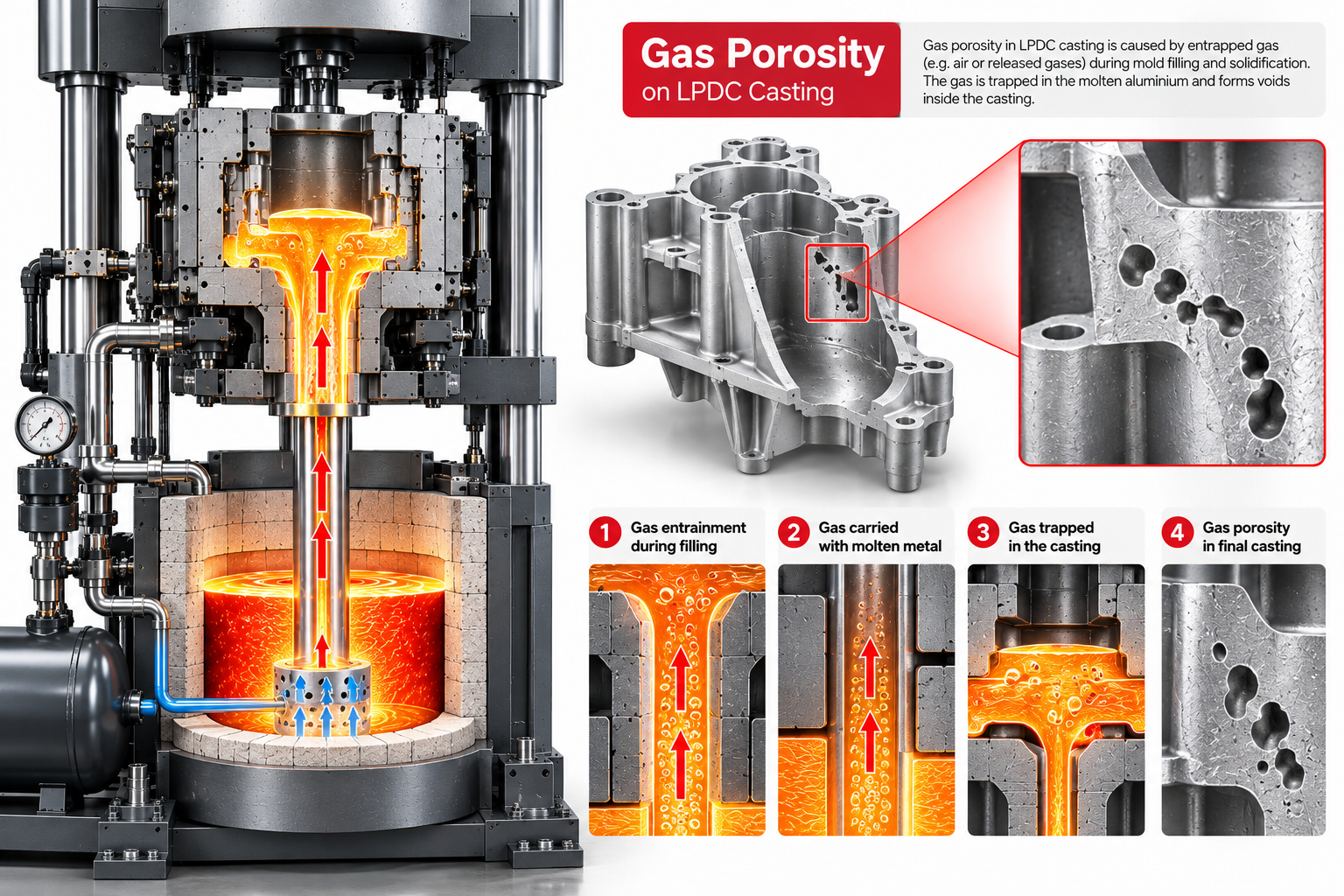
Gas Porosity consists of cavities formed by trapped gas or gas released from the metal during Solidification. Potential causes include Molten Aluminium quality, filling conditions, contamination, and other process characteristics. Operators can reduce risk through suitable Melt Treatment, melt cleanliness controls, and evaluation of the pressure profile and venting system.
5.2 Shrinkage Porosity
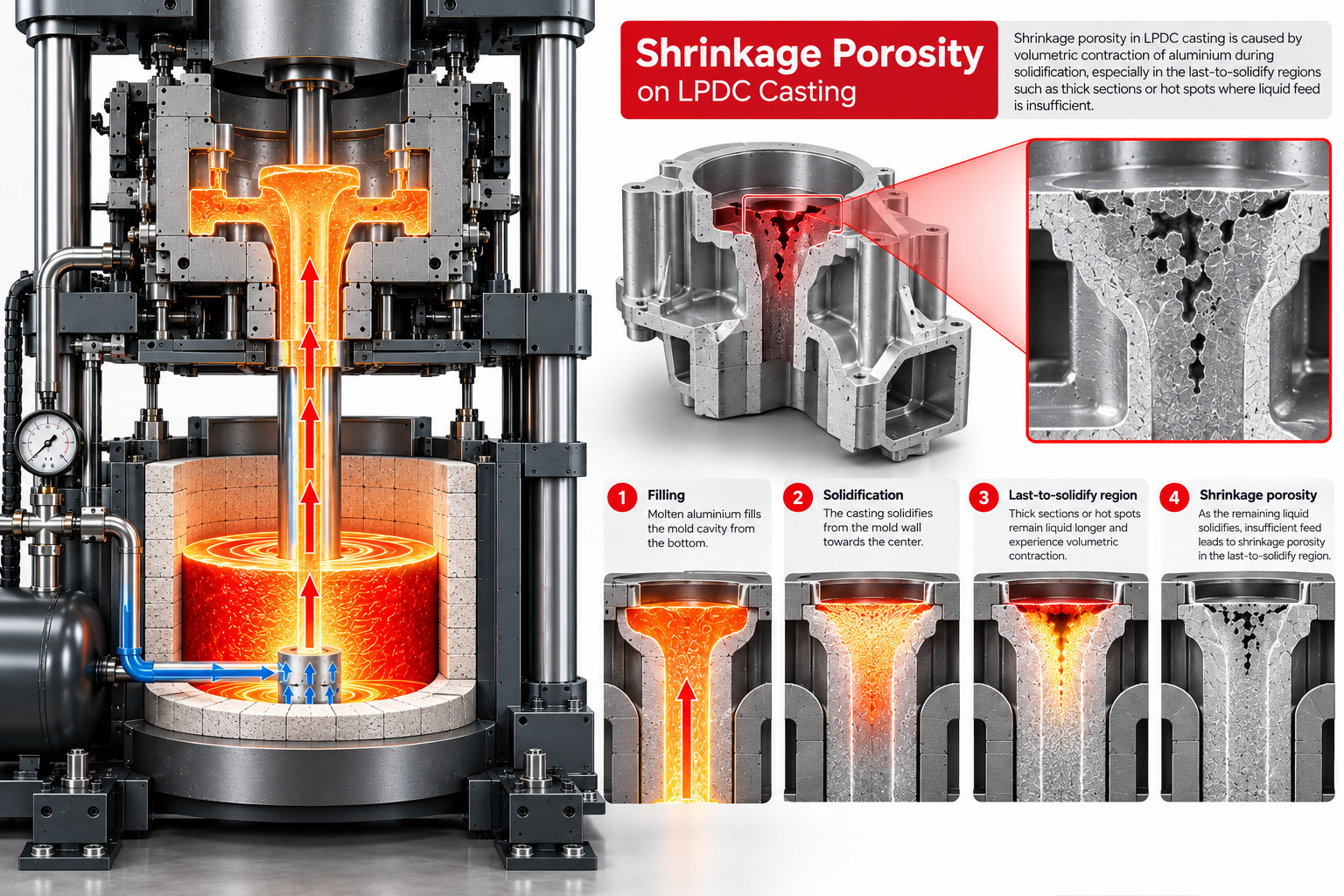
Shrinkage Porosity occurs when contraction during Solidification cannot be compensated for by an adequate supply of liquid metal. Risk may increase in thick sections or Hot Spots that solidify later, particularly if the feeding path freezes before contraction is complete. To prevent this defect, engineers should evaluate Die design, the feeding system, temperature, cooling strategy, and Pressure Holding.
5.3 Misrun and Cold Shut
A Misrun occurs when metal fails to fill the entire Die cavity. A Cold Shut occurs when two metal flow fronts meet but do not fuse properly. Low metal temperature, heat loss during filling, excessive filling time, or an unsuitable pressure profile can contribute to these defects.
5.4 Oxide Inclusions
Oxides can form when the surface of Molten Aluminium reacts with the surrounding environment, or when oxide films are carried into the metal. Controlled filling can help reduce turbulence, but it cannot eliminate every possibility of oxide formation or entrainment. Good molten-metal handling and flow control remain essential.
5.5 Dimensional Variation and Surface Defects
Dimensional variation and surface defects can be influenced by Die condition, temperature, deformation, Ejection, and downstream operations. Visual inspection alone may not be sufficient to verify internal quality. Inspection methods should be selected according to the component’s function and technical requirements.
6. LPDC Applications Across Industries
LPDC is commonly used for aluminium components that require suitable casting quality and process consistency. Actual applications depend on product design, alloy, mechanical requirements, production volume, and process feasibility.
6.1 Automotive Industry
One widely recognized application of LPDC is the production of Aluminium Alloy Wheels. The process may also be used for other automotive components when the design and quality requirements are compatible with LPDC capabilities.
6.2 Engine and Powertrain Components
LPDC may be used to manufacture components such as cylinder heads or certain engine parts, provided that the design, alloy, and product requirements are suitable for the process.
6.3 Industrial Components
Beyond automotive applications, LPDC may be considered for industrial components requiring particular geometries and quality characteristics. Choose a process based on technical requirements rather than product shape alone.
7. LPDC vs. HPDC: Key Differences
| Aspect | LPDC | HPDC |
|---|---|---|
| Filling mechanism | Gas pressure pushes metal from the furnace through a Riser Tube. | A Plunger injects metal into the Die through a Shot Sleeve. |
| Flow characteristics | Controlled filling using a managed pressure profile. | High-speed injection. |
| Solidification control | Pressure can be maintained to support Feeding while the supply path remains open. | Managed through Die design, thermal conditions, and intensification parameters. |
| Typical applications | Aluminium Alloy Wheels and selected components requiring suitable casting quality. | Complex components for high-volume production, including many automotive parts. |
| Production considerations | Cycle and machine configuration must suit component size and requirements. | High productivity, with appropriate filling control and process design required. |
LPDC is not a universal replacement for HPDC, and vice versa. Process selection should consider geometry, wall thickness, production volume, quality targets, heat-treatment requirements, and total manufacturing cost.
8. Key Factors in LPDC Process Optimization
Engineers should optimize LPDC systematically. The goal is not simply to increase pressure or shorten the cycle, but to identify a parameter combination that delivers stable quality and appropriate productivity.
- Establish a process baseline. Record pressure, temperature, filling time, Pressure Holding, Solidification time, and inspection results.
- Identify defect patterns. Document each defect’s type, location, frequency, and severity to support root-cause analysis.
- Evaluate the Pressure Profile. Check whether the pressure rise and holding stage suit the Die and component characteristics.
- Review Die design and cooling. Investigate potential Hot Spots, feeding paths that freeze too early, and areas that challenge filling.
- Validate parameter changes. Run controlled trials and relevant inspections before implementing changes across production.
- Standardize validated parameters. Document process settings and monitor production variation to maintain consistency.
For critical components, Casting Simulation can help assess filling patterns, temperature distribution, and Solidification before design or process changes are implemented. Engineers should still validate simulation results against production data and actual inspection results.
9. Conclusion
Low Pressure Die Casting uses gas pressure to fill a Die from below in a controlled manner. This characteristic helps operators manage metal flow and maintain the metal supply during Solidification.
Process success depends on the balance between the Pressure Profile, Molten Aluminium temperature, Die temperature, filling system design, melt quality, and cooling strategy.
To achieve consistent casting quality, engineers should treat pressure control as part of an integrated process system. Parameter monitoring, defect analysis, trial validation, and Casting Simulation can help improve process consistency and production effectiveness.
By understanding the relationship between metal filling, pressure control, and Solidification, engineers can develop a more stable LPDC process that meets industrial component requirements.
10. Technical References
- Woycik, G. G., & Peters, G. (2008). “Low-Pressure Metal Casting.” ASM Handbook, Volume 15: Casting, pp. 700–708. ASM International. https://doi.org/10.31399/asm.hb.v15.a0005261
- Nunes, H., Emadinia, O., Vieira, M. F., & Reis, A. (2023). “Low- and High-Pressure Casting Aluminum Alloys: A Review.” IntechOpen. https://doi.org/10.5772/intechopen.109869
- “Advanced Process Simulation of Low Pressure Die Cast A356 Aluminum Automotive Wheels—Part I, Process Characterization.” Metals, 10(5), 563. https://www.mdpi.com/2075-4701/10/5/563
- “Industry 4.0 Foundry Data Management and Supervised Machine Learning in Low-Pressure Die Casting Quality Improvement.” International Journal of Metalcasting. https://link.springer.com/article/10.1007/s40962-022-00783-z

Your Industrial Solutions Partner
PTWI Low Pressure Die Casting Machine Solutions
PT Wilisindomas Indahmakmur (PTWI) provides Low Pressure Die Casting (LPDC) machines to support efficient and reliable production in the Aluminium Die Casting industry.
Contact our team to discuss machine specifications, configuration options, and solutions suited to your production requirements.
Discuss Your Requirements